3 brand voice mistakes creatives make on their website (and how to fix them)
Ever feel like you’ve rewritten your website copy so many damn times that THIS time, it’s gotta be “right”. But you’re still not getting the enquiries you want?
You already have the website, so congrats (that’s more than some people have). But the enquiries coming through don’t seem to be from clients in your niche, or ones that feel like a good fit, so you feel stuck.
Or maybe you’re getting more enquiries through social media and referrals, and you’re tapping your enquiry form being like “Uuummm, is this bloody thing on?”
If this is you, it could be because the copy on your website is:
Not capturing attention
Not resonating with your audience
Not keeping your audience engaged enough to keep reading
It’s easy to make these mistakes, especially when you overthink your website copy.
Sound familiar?
And this is where I want to talk about your brand voice.
You already have an idea of your brand voice. You know the personality you are going for when you write content, and that’s great. You even use it naturally when you talk on client calls! The trouble is, it’s inconsistent and doesn't shine through on your website.
I love helping my clients amplify their brand voice. But the same mistakes pop up again and again when they try to show their brand voice and still don’t feel quite right.
So in this post, I’m sharing 3 common brand voice mistakes that I’ve seen creative service providers make, and how to start fixing them.
Okie doke, let’s get into it!
Mistake 1: Your website copy sounds nothing like your Instagram
This is an easy mistake to make, because when we think “website”, we think “sell”. So, as creatives, we tend to hide our personality because we panic and spiral into those 2am thoughts that are just so fun. Am I right or am I right?
You might default to “corporate mode”, being over-professional with your language, resulting in stiff, lifeless copy (more about this in mistake number 2).
When you use your brand voice on Instagram in your talking reels, captions, or stories, it feels more natural because you are trying to spark conversations. You’re speaking up about your opinion, sharing hot takes and showing your incredible work. So you’re just being yourself!
But the problem here is that your potential client sees two completely different versions of you.
They see your socials, which are natural and conversational, but then they click through to your website, and it all just sounds, well…flat.
It may give them the wrong impression of you and not fully show your authority and credibility. This breaks trust and makes your potential client question whether you are the right creative service provider for them.
How to fix the disconnect:
Open up your social media profiles and find a few posts that resonated with your audience. Look at your stats and see if you got shares, saves or positive comments. Compare your voice, language and tone in these posts and see if it matches your website copy.
Ask yourself: If someone read this post and then checked out my website right after, would it sound like me?
If the answer is no, find a way to weave some of that ‘so you’ energy from your posts into your website copy. Find the raw personality elements and reflect that. You can still “sell”, but you want it to actually sound like it’s YOU talking, and in a way your audience can understand clearly.
Mistake 2: Defaulting to “corporate” sounding website copy because it feels safer
This is a huge one, because I see it all the time.
As humans, we can be so fearful of rejection. And that’s completely normal and understandable (anxiety-ridden coffee addict here!) You might worry about giving the wrong impression or scaring ideal clients away.
Because of that, you hold back, hiding your personality and all the wonderful and weird things that make you, well, you. As a result, your copy ends up sounding like a boring, generic, watered-down version of yourself you left behind at your corporate job many yonks ago (or worse, you sound like your “friend” Chatty G 🤖).
This is exactly what happened to my client, Elisa (website designer and copywriter). She was afraid to show her vibrant, sassy personality through her website copy. She wasn’t speaking to her ideal client, addressing their pain points enough, or explaining why she was specifically the one to help them solve their problem.
And because of this, she felt like she had to over-explain herself on discovery calls and really “prove” herself in her marketing. She felt so disconnected from her website, and she was embarrassed by it.
She was using generic phrases like “creative partner”, “elevate your business”, and “turn browsers into buyers”.
While these phrases feel familiar, they don’t actually differentiate you from any other service provider out there. So when your copy isn't specific or engaging, you become instantly forgettable, and your ideal client will yawn their way to your competitor’s website instead.
How to fix your vanilla vibes:
This is where you will need to put your thinking cap on. Think about conversations you have IRL, online and in your DMs.
What phrases do you use that are unique to you, that you say often? Do your friends tell you that you say “cool beans” a lot? If you do, put that through your website copy (yes, really). Even make it a recurring theme if you think it fits. Little things like this help you become memorable and stand out (and show you are human!)
For example: I like to say “Ahoy” to my audience instead of “Hello”. I use this often, and when I do, my audience knows it’s me straight away.
When you imagine talking to your dream client, what words are they using to describe their pain points? Are they saying things like “I feel stuck” or “my logo doesn’t feel like me, I think it looks sh*t”? If that’s what they are saying, you guessed it—include it in your website copy.
Think about your ideal client. What industries are they in, what are their personalities like, and what stage in the journey are they in that they would want to work with you? You want to make sure you are always using a tone of voice that resonates with them and where they are at.
For example: If you want to attract fun brands similar to Who Gives a Crap, your brand voice needs to match their quirky energy. If you would rather attract small businesses in the health and wellness space, then your sentences might be softer and more flowy.
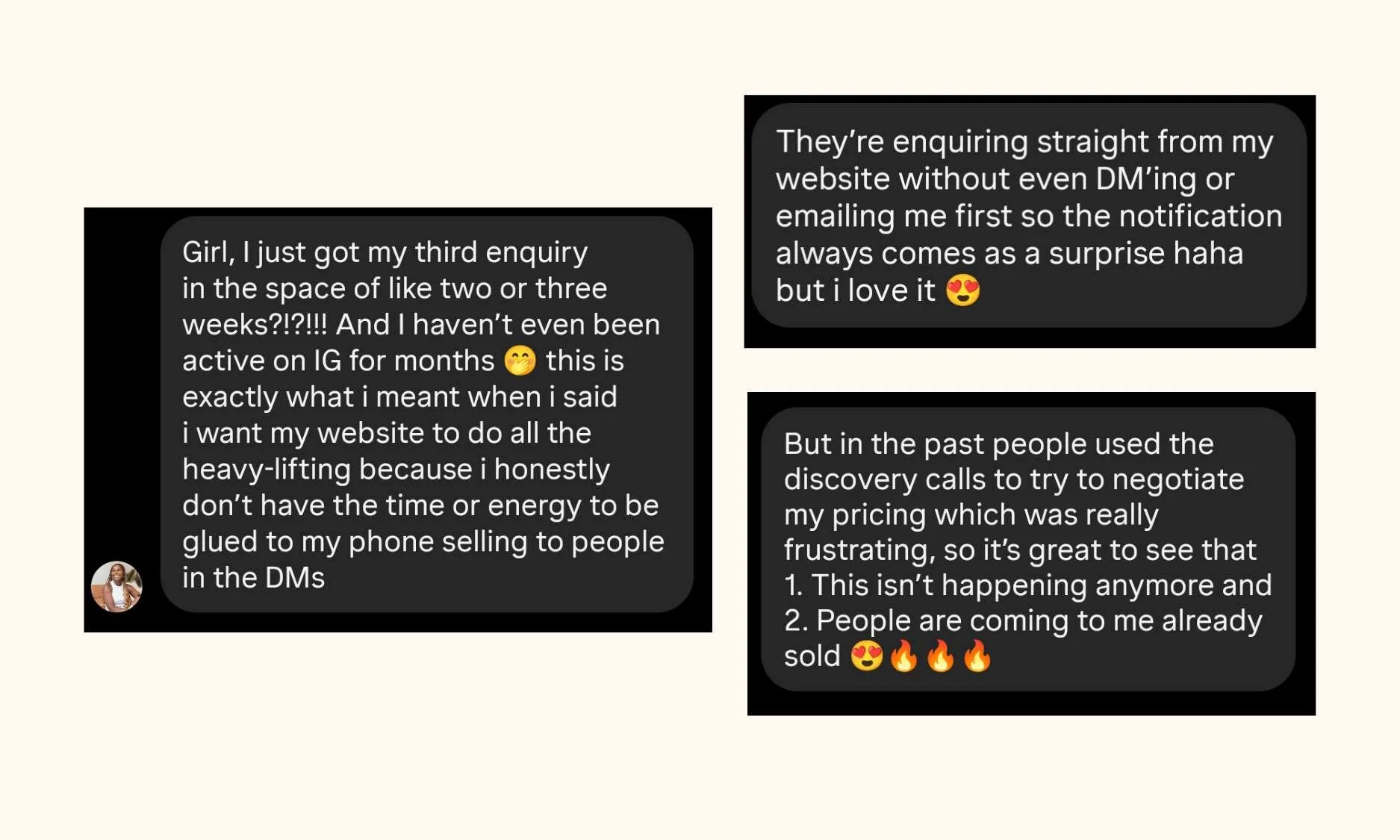
Bonus tip: Always think about how you can balance your ideal client’s language with your own to build a strong brand voice and tone. Once I amplified my client Elisa’s brand voice through her website copy, she finally attracted the clients she wanted. She now gets more aligned enquiries because her copy is specific and full of her unique personality. Here’s what she said:
Mistake 3: Thinking your visuals on your website can do all the talking for you
Yes, your visuals on your website are amazing. You do such a good job at showing your beautiful work. But despite what you think, your images do not speak for themselves. Ooof, we’re getting a bit spicy up in here!
Now, I see so many creatives’ websites that neglect copy because they want their visuals to be front and centre. And that totally makes sense if you are a designer, photographer, or artist. But your visuals and your website design are there to attract your ideal client, and your copy is there to convert them.
So if you are lacking copy that explains your process, story, style and differentiators, your visuals will not be enough to make your ideal client hit that “let’s work together button”.
A lot of the time, I see minimal copy, with zero brand voice. For example, your portfolio page might be a bunch of stunning, ‘end result’ photos of projects you worked on, with a summary about the client’s company and the deliverables you provided.
This doesn’t tell your ideal client anything about why they should trust you and hire you. If your brand voice isn't evident on every page of your website, your ideal client might suddenly think, “Hey, where did you go?”
How to fix your vague portfolio:
Don’t rely solely on visuals to carry the weight for you. Back them up with copy.
If you are showing client work on your portfolio page, give your next client an actual reason to hire you rather than just “this looks good”. Talk about your thought process with the project:
What did the client want?
What were they struggling with?
What was your approach?
What was the outcome?
This should all be written in your brand voice, as if you are telling a story. This builds trust and connection with your reader and makes them think, “How working with this person sounds awesome; maybe they can help me too”.
Remember, when you are writing case studies, try not to default to a flat tone of voice. This happens often if you are thinking really hard about explaining yourself! Use the phrases you and your ideal client would use, and keep it simple and easy to digest. This keeps every page on your website consistent and predictable, and positions you as a top choice.
Bonus tip: Create brand voice guidelines for yourself. Just like you would create a visual branding style guide for your clients (or your own visual brand), make a document all about your approved words and phrases.
This way, you can refer to it whenever you need to, without wracking your frazzled brain or going back to square one every time you write content. This also helps everything stay consistent, so you can be sure you sound like you everywhere you show up online.
Let’s wrap this up
If you've been making these brand voice mistakes on your website, don’t sweat it.
In school (the good old days), we were taught a certain way to write where we had to strive for perfection. Unfortunately, it’s stuck with us (like English essays, gosh, who could be f*cked!) But that type of writing doesn’t translate well into website copy when you are trying to build a personal brand, grow your creative business and sell.
Once you know how to incorporate and amplify your unique brand voice through your website copy, you can start making the changes you need to attract and convert aligned clients.
In fact, by reading this post, you’ve just taken a huge step toward doing that. Hell yeah!
But if you try again and you feel cbf, and you want me to translate your brand voice through your website copy for you, check out:
The Chosen One Website (done-for-you website copywriting) or
The Persuasion Blindspot Audit (website copy audit, DIY with guidance).
Both of these kickass copywriting services will help put your unique brand voice front and centre on your website, so you can stop missing out and start standing out.
(Oof, I probably could have come up with a better line there, but you know what, that’s my brand voice. I’m a bit of an awkward nerd!)
Anyway, until next time, stay cool as a cucumber.